
Free Protein Structure Prediction Certification Assessment | StemSkills Lab
Skip to content

Free Protein Structure Prediction Certification Assessment

Test your knowledge of protein structure prediction: AlphaFold confidence scores (pLDDT and PAE), homology modelling with SWISS-MODEL and MODELLER, and model validation. Pass at 70% to earn a verifiable StemSkills certificate. Download it as a PDF and add it to your LinkedIn profile. It is free.
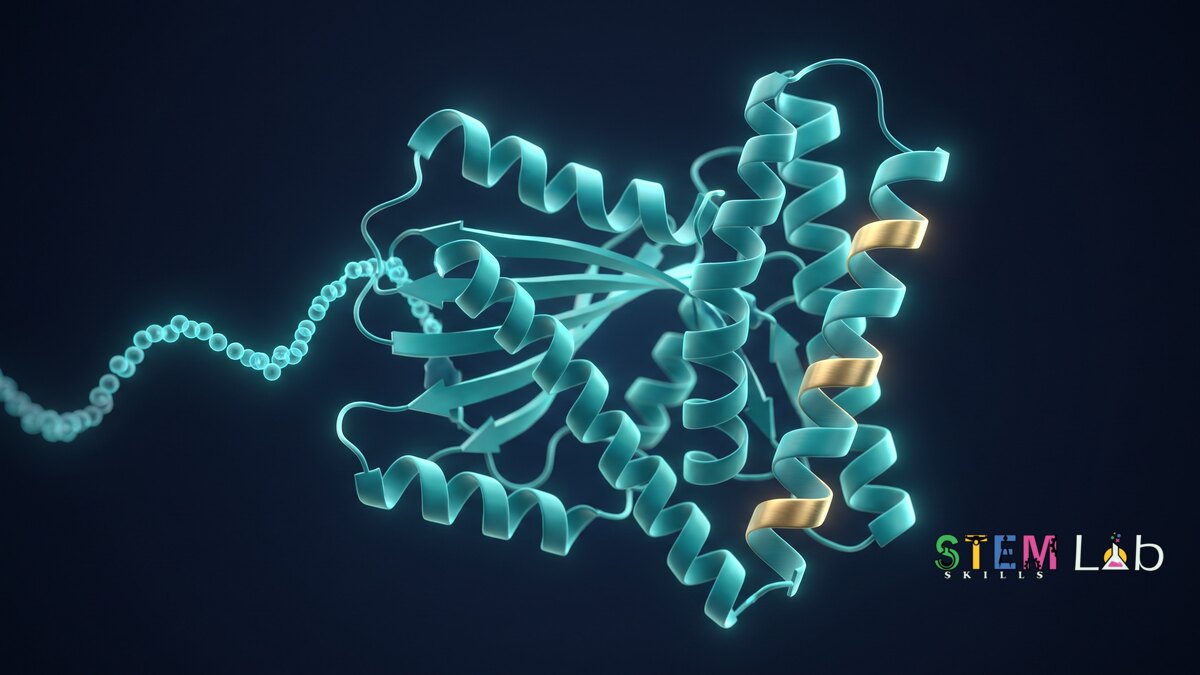
Protein Structure Prediction certification assessment

1
Take the quiz
20 questions on protein structure prediction. A 20-minute timer runs once you start. No sign-up needed to start.
2
Sign in to see your result
One click with Google. Your score is saved to your account so you can see whether you passed.
3
Pass? Get certified
Score 70% or more and download your verifiable certificate, then add it to LinkedIn.
time left:
:
:

Protein Structure Prediction Certification Assessment

Submit quiz
Once you submit, you will no longer be able to change your answers. Are you sure you want to submit the quiz?

Free certification assessment. Pass at 70% to earn a verifiable StemSkills certificate.

1.
In an AlphaFold model, pLDDT is:
The percentage sequence identity to the template
A per-residue confidence score from 0 to 100
The resolution of the model in Ångströms
The predicted binding affinity of a ligand
2.
A residue with pLDDT above 90 is interpreted as:
Probably disordered
Very high confidence
Not modelled
Low confidence
3.
A long stretch of residues with pLDDT below 50, drawn as a wide loop around a confident core, most likely represents:
A region that is disordered or unstructured in isolation
A well-defined beta sheet
An error in the sequence file
The active site
4.
The Predicted Aligned Error (PAE) plot reports:
The expected position error at one residue when the model is aligned on another residue
The sequence conservation at each position
The energy of each residue in kcal/mol
The number of hydrogen bonds per residue
5.
A two-domain model has pLDDT above 90 in both domains, but the PAE between the domains is high. The correct reading is:
The protein must be a dimer
Each domain is reliable, but their relative placement is not
The whole model can be trusted as drawn
Both domains are unreliable
6.
In coordinate files downloaded from the AlphaFold Database, the pLDDT value for each residue is stored in:
The occupancy column
The chain identifier column
The B-factor column
A separate text file only
7.
Besides the amino-acid sequence, the main evolutionary input AlphaFold 2 uses is:
A multiple sequence alignment of related sequences
A gel image
A molecular dynamics trajectory
A mass spectrum
8.
ColabFold produces predictions faster than the original AlphaFold 2 pipeline mainly because it:
Runs without any sequence alignment
Uses a smaller protein
Skips the neural network
Replaces the homology search with a fast MMseqs2 search
9.
SWISS-MODEL is best described as:
A docking program
A molecular dynamics engine
An automated homology modelling server
A sequence database
10.
In SWISS-MODEL, the GMQE score is:
The RMSD to the template in Ångströms
A number between 0 and 1 where higher means higher expected model quality
An energy in kcal/mol where lower is better
A percentage of residues in loops
11.
Your target shares about 20% sequence identity with the best available template. The most accurate statement is:
Sequence identity does not affect model quality
Homology modelling will be highly accurate
No structure can ever be predicted for this protein
This is the "twilight zone", where alignment errors are likely and the model needs extra caution
12.
MODELLER builds a homology model by:
Docking the target into the template
Copying the template coordinates without change
Running a long molecular dynamics simulation in water
Satisfying spatial restraints derived from the target-template alignment
13.
MODELLER generated five models. Using the DOPE score alone, you would select the model with:
The longest file
A DOPE score closest to zero
The highest (least negative) DOPE score
The lowest (most negative) DOPE score
14.
The two axes of a Ramachandran plot are:
pLDDT and PAE
RMSD and time
Bond length and bond angle
The backbone dihedral angles phi and psi
15.
By the PROCHECK guideline, a good-quality model is expected to have:
About 70% of residues in the most favoured regions
Under 50% of residues in the most favoured regions
Every residue in a disallowed region
Over 90% of residues in the most favoured regions
16.
When several templates are available, the best choice is usually the one with:
The shortest chain
The largest number of water molecules
The oldest deposition date
High sequence identity and coverage of the target, solved at good resolution
17.
For a protein complex predicted with AlphaFold-Multimer, the score that specifically estimates the accuracy of the interface between chains is:
pLDDT
ipTM
DOPE
GMQE
18.
Compared with AlphaFold 2, AlphaFold 3 can additionally predict:
Complexes that include nucleic acids, small-molecule ligands, ions and modified residues
Reaction rates of enzymes
Only shorter proteins
Only membrane proteins
19.
You predict the wild-type and a single point mutant with AlphaFold and the two models look identical. The sound conclusion is:
The mutation must be in a disordered region
The mutation has no effect on the protein
The mutant sequence was entered wrongly
No conclusion about the mutation, because AlphaFold is not validated for predicting the effect of point mutations
20.
Before docking a ligand into a predicted model, the most important check is:
That the binding-site residues are predicted with high confidence and sound geometry
That the model has more than 500 residues
That the model contains no hydrogen atoms
That the file name is short
  • 1
  • 2
  • 3
  • 4
  • 5
  • 6
  • 7
  • 8
  • 9
  • 10
  • 11
  • 12
  • 13
  • 14
  • 15
  • 16
  • 17
  • 18
  • 19
  • 20
Ready to go beyond the assessment?
Our live, mentor-led cohort takes you hands-on through protein modelling, docking and molecular dynamics, finishing with a project you build yourself and can show on your CV and applications.

See the live cohort

See live workshops