Final-year BSc
You have done the biology and the chemistry, and now a project needs a computer. Start with the free assessment and the guides, then take the live cohort if your project involves docking or simulation.
Online, live, taught by researchers who publish
Four steps, from a free self-test to a real research project. Start wherever you are.
StemSkills Lab teaches computational life sciences online in four steps: a free skills assessment, free step-by-step guides, a live small-batch cohort in molecular docking and MD simulations, and a hands-on research project. Teaching is by PhD researchers with 70+ peer-reviewed papers and more than 1,390 citations.

Three of the four steps are free. Start at whichever one matches what you can already do.
Free
Take a short assessment in molecular docking, MD simulations, biomolecular modelling or protein-protein modelling. Pass and you get a certificate you can verify and share.
Free
Step-by-step tutorials with the real commands: installing GROMACS, preparing a protein and ligand, running your first simulation, reading docking results, analysing a trajectory.
Paid, limited seats
Molecular modelling, docking and MD simulations, taught live in a small batch over about two months. You run the full pipeline yourself, from structure preparation to binding free energy.
Paid, by enquiry
Hands-on training on a specific, publishable question, run alongside a team that publishes. The output is work you can take into your thesis or a paper.
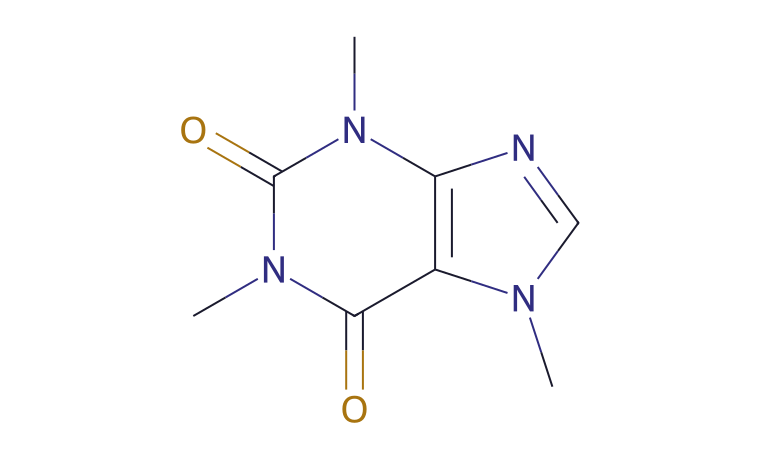
You work with real structures from the first guide onward.
The guides and the live cohort use the same open-source tools and the same file formats a working lab uses, so what you practise on transfers to your own system.
The same live sessions, aimed at what you need next.
You have done the biology and the chemistry, and now a project needs a computer. Start with the free assessment and the guides, then take the live cohort if your project involves docking or simulation.
Your dissertation needs a method you have not been taught. The live cohort walks the whole pipeline, from preparing a structure to analysing a trajectory, so the methods section writes itself from work you actually did.
You need the pipeline to be reproducible and defensible, not just to run once. Sessions go into force-field choice, parameterisation, convergence and free-energy calculations, with a team that has published on these methods.
You are expected to supervise computational projects you were never trained in. Take the same cohort, or talk to us about training a group from your department together.
The methods are not abstract for us.
The team publishes on these systems, and the sessions on parameterisation, convergence and free energy are drawn from that work rather than from a textbook.
Fees are shared privately once you enquire, so we can tell you what applies to your country and your situation.