
How to Validate a Protein Structure: Ramachandran Plots and MolProbity Scores Explained
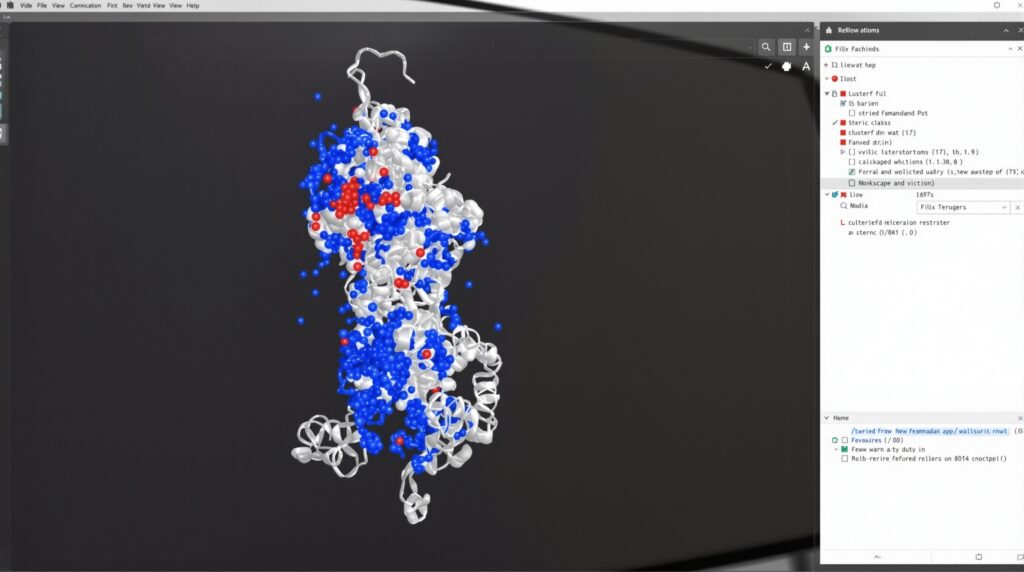
To validate a protein structure, check its stereochemistry, not just its confidence score. Run the model through MolProbity or a Ramachandran plot: aim for more than 98% of residues in favoured backbone regions, a near-zero clashscore, and under 0.3% rotamer outliers. Those numbers tell you whether the model is safe to dock or simulate.
You have just built a model, maybe from AlphaFold or by homology modelling in SWISS-MODEL, and now you need to prove it is good enough to use. Docking a bad structure or running molecular dynamics on it wastes days of compute and produces results a reviewer will not trust. This guide shows an MSc student how to run the standard stereochemical checks, read every number correctly, and decide whether to trust the model or fix it. It sits inside the wider computational biology skills roadmap, where validation is the gate between building a structure and using it.
What does it mean to validate a protein structure?
Validation means checking that the physical geometry of your model is chemically reasonable: that bond lengths and angles are normal, that atoms do not overlap, and that the backbone and side chains sit in conformations that real proteins actually adopt. This is separate from a confidence score.
Beginners often confuse the two. An AlphaFold pLDDT value or a SWISS-MODEL QMEANDisCo score tells you how confident the prediction method is about its own output. It does not guarantee the atoms are physically sensible. A model can have high confidence in a region and still contain a steric clash or a strained side chain that will destabilise a simulation. Stereochemical validation is the independent, method-agnostic check that catches those problems, which is why the worldwide Protein Data Bank (wwPDB) runs it on every new deposition before release.
The two workhorse checks are the Ramachandran plot for the backbone and the MolProbity suite for the whole all-atom model. Learn to read both and you can validate almost any structure.
What is a Ramachandran plot and how do you read it?
A Ramachandran plot maps the two main backbone dihedral (torsion) angles of each residue: phi (the rotation around the N to Cα bond) against psi (the rotation around the Cα to C bond). Because neighbouring atoms collide at most angle combinations, only certain phi/psi pairs are physically allowed, so real residues cluster in a few well-defined zones.
The plot was introduced by G. N. Ramachandran and colleagues in 1963 in their paper “Stereochemistry of polypeptide chain configurations” in the Journal of Molecular Biology, and it has been the standard backbone sanity check ever since. Every point you see falls into one of three zones:
- Favoured: the dense core regions where the great majority of residues in high-quality structures sit (the alpha-helix and beta-sheet basins).
- Allowed: the wider ring around the favoured cores. Legal, but less common.
- Outlier (disallowed): combinations that are sterically strained. A residue here is a red flag unless there is a strong structural reason, such as a functional glycine.
Glycine is the exception to watch. With no side chain, it can occupy regions forbidden to every other residue, so validation tools plot glycine, proline, and pre-proline residues separately. An outlier that turns out to be a glycine is often fine.
What counts as a good Ramachandran result?
The favoured regions were contoured to enclose 98% of residues from a large reference set of high-quality experimental structures (Lovell and colleagues, 2003, Proteins). That single fact sets the target: a good model should place more than 98% of residues in favoured regions and have essentially no outliers. MolProbity prints the exact goals in its report as “Ramachandran favored, Goal: >98%” and “Ramachandran outliers, Goal: <0.05%”. If your model shows 90% favoured and a scatter of outliers outside loops, the backbone needs work before you go further.
What is MolProbity and which scores matter?
MolProbity is a free web service that runs a full battery of all-atom stereochemical checks in one pass. It adds and optimises hydrogen atoms, then measures every kind of geometric problem at once. Chen and colleagues describe it in their 2010 paper in Acta Crystallographica Section D, where the abstract states:
“MolProbity is a structure-validation web service that provides broad-spectrum solidly based evaluation of model quality at both the global and local levels for both proteins and nucleic acids.”
The reference data behind it was later expanded by Williams and colleagues in 2018 in Protein Science. When you read a MolProbity report, these are the numbers that decide whether a model passes.
| Metric | What it measures | Goal (from MolProbity) |
|---|---|---|
| Clashscore | Number of serious steric overlaps (atoms closer than 0.4 Å) per 1000 atoms | As low as possible; near 0 for a good model |
| Poor rotamers | Side chains in rare, strained conformations | <0.3% |
| Ramachandran outliers | Backbone phi/psi in disallowed regions | <0.05% |
| Ramachandran favoured | Backbone phi/psi in the dense core regions | >98% |
| Cβ deviations | Cβ atoms displaced more than 0.25 Å from ideal | 0 |
| Bad bonds / angles | Bond lengths and angles far from standard values | Bonds 0%, angles <0.1% |
The clashscore is the single most useful global number. It counts every pair of non-bonded atoms overlapping by more than 0.4 Å, normalised per 1000 atoms so it is comparable across proteins of any size. A clashscore of 0 is excellent, and well-built structures usually sit below 5.
The MolProbity score rolls the clashscore, poor-rotamer percentage, and Ramachandran non-favoured percentage into one log-weighted number, scaled so it approximates the resolution (in ångström) at which those values would be typical. Lower is better. It is handy for comparing two candidate models at a glance, but always read the individual metrics too, because one bad clash can be hidden inside a decent average.
Want the guided, hands-on version?
Our live Molecular Modeling & MD Simulations cohort bootcamp takes you from zero to running real docking and MD workflows, with a portfolio project for your grad-school applications.
How do you actually run these checks, step by step?
The fastest route is the MolProbity web server. Nothing to install, and it handles hydrogens for you.
- Open the server. Go to molprobity.biochem.duke.edu and click “Start a new session”.
- Upload your model. Load the PDB (or mmCIF) file of the structure you built. Give it a clear name.
- Add hydrogens. Choose “Add hydrogens” and let MolProbity run its Reduce step. All-atom clash detection needs hydrogens in place, so this is not optional.
- Run the analysis. Select “Analyze all-atom contacts and geometry”. MolProbity computes the clashscore, rotamer and Ramachandran statistics, Cβ deviations, and bond geometry.
- Read the summary chart. The multi-criterion table shows each metric with a colour code (green good, yellow marginal, red poor) and its goal value. Note anything red.
- Inspect the outliers. Download the per-residue lists and, if you want a visual, the kinemage view that draws clashes as pink spikes directly on the structure so you can see where the trouble is.
If you prefer a second opinion, the SAVES server at UCLA bundles the classic PROCHECK, ERRAT, and VERIFY3D tools in one submission, and the ProSA-web server gives an energy-based Z-score. Running two independent tools and seeing them agree is good practice for anything going into a thesis.
Which validation tool should you use?
For a model destined for docking or MD, MolProbity is the most complete single check because it looks at all atoms, not just the backbone. The others are useful as confirmation or for specific angles.
| Tool | What it checks | Key output | Best for |
|---|---|---|---|
| MolProbity | All-atom clashes, Ramachandran, rotamers, Cβ, bond geometry | Clashscore, MolProbity score, outlier lists | The default full stereochemical check before docking or MD |
| PROCHECK (via SAVES) | Ramachandran, bond lengths and angles, chi angles | Ramachandran plot, G-factors, per-residue plots | Classic backbone and geometry check still expected by some journals |
| ERRAT / VERIFY3D (via SAVES) | Non-bonded atom distributions; sequence-structure compatibility | Overall quality factor; 3D-1D profile | A quick second opinion, useful for lower-resolution models |
| ProSA-web | Knowledge-based energy of the fold | Z-score plotted against known structures | Checking that the overall fold sits in the native range |
| wwPDB validation server | The full deposition-grade battery (uses MolProbity metrics) | Standard validation report with percentile sliders | A referee-style report you can attach to a thesis or paper |
How do you fix a model that fails validation?
A failed check is a starting point, not a dead end. Match the problem to the fix.
- High clashscore (say 20 or more): the atoms are colliding. First, make sure hydrogens were added correctly, then run a short energy minimisation (for example in GROMACS, or with the “regularise” tools in Coot) to relieve the overlaps without moving the backbone much. Re-run MolProbity afterwards.
- Poor rotamers above 0.3%: individual side chains are in rare conformations. Open the model in Coot and use its rotamer tools to flip each flagged residue to the nearest common rotamer, guided by the surrounding contacts.
- Ramachandran outlier inside a loop: loops are the least reliable part of any model. Rebuild the loop (SWISS-MODEL and MODELLER both offer loop refinement) rather than forcing the existing geometry.
- Ramachandran outlier that is a glycine: often no fix is needed. Confirm the residue identity before you touch it.
- Systematic bad bonds or angles across the whole model: this usually means a broken input file or a failed build. Rebuild from a cleaner template rather than patching residue by residue.
After any fix, validate again. Validation is a loop, not a one-time stamp, and a clean second report is what lets you move on to docking with confidence.
Do AlphaFold models need validation too?
Yes. AlphaFold structures generally have excellent Ramachandran statistics because the network learned real backbone geometry, but that does not exempt them from a MolProbity check. The per-residue pLDDT confidence (very high above 90, confident 70 to 90, low below 50 on the AlphaFold scale) tells you which regions to trust, and low-confidence loops and tails are exactly where clashes and strained side chains hide. Trim or rebuild the very-low-confidence stretches, then validate the part you actually intend to dock or simulate. Treat pLDDT and the stereochemical report as two different questions: one asks “how sure is the prediction”, the other asks “is the chemistry real”.
Frequently asked questions
Is a good pLDDT or QMEAN score enough to skip validation?
No. Those scores rate the prediction’s confidence, not the physical geometry. A confident region can still contain a steric clash or a strained rotamer. Always run an independent stereochemical check such as MolProbity before docking or MD.
What is a good MolProbity score?
Lower is better, because the score approximates the resolution at which the model’s geometry would be typical. For a usable model, aim to keep the clashscore near zero, Ramachandran favoured above 98%, and poor rotamers under 0.3%, and the composite score will follow.
What is the difference between a Ramachandran outlier and an allowed residue?
An allowed residue sits in a legal but less common phi/psi region and is usually fine. An outlier sits in a disallowed, sterically strained region and needs a reason (like a functional glycine) or a fix.
Do I need to add hydrogens before validating?
For all-atom clash detection, yes. MolProbity adds and optimises hydrogens automatically as part of its workflow, so on the web server you simply run the “Add hydrogens” step before the analysis.
Which single check should I run if I only have time for one?
Run MolProbity. It covers the Ramachandran backbone check plus all-atom clashes, rotamers, and Cβ geometry in one pass, which is why it is the standard for models heading into docking or simulation.
Validation is written and maintained by the StemSkills Lab team, who bring more than ten years of work in sequence and structural bioinformatics, drug discovery and design, and multiscale molecular modeling. When you can read a Ramachandran plot and a MolProbity report without hesitation, you stop guessing whether a model is good and start knowing, which is exactly the judgement graduate programs and research groups look for. See how the whole workflow fits together in the computational biology skills roadmap.
Want the guided, hands-on version?
Our live Molecular Modeling & MD Simulations cohort bootcamp takes you from zero to running real docking and MD workflows, with a portfolio project for your grad-school applications.