
TIP3P vs SPC/E vs TIP4P: Which Water Model in GROMACS?
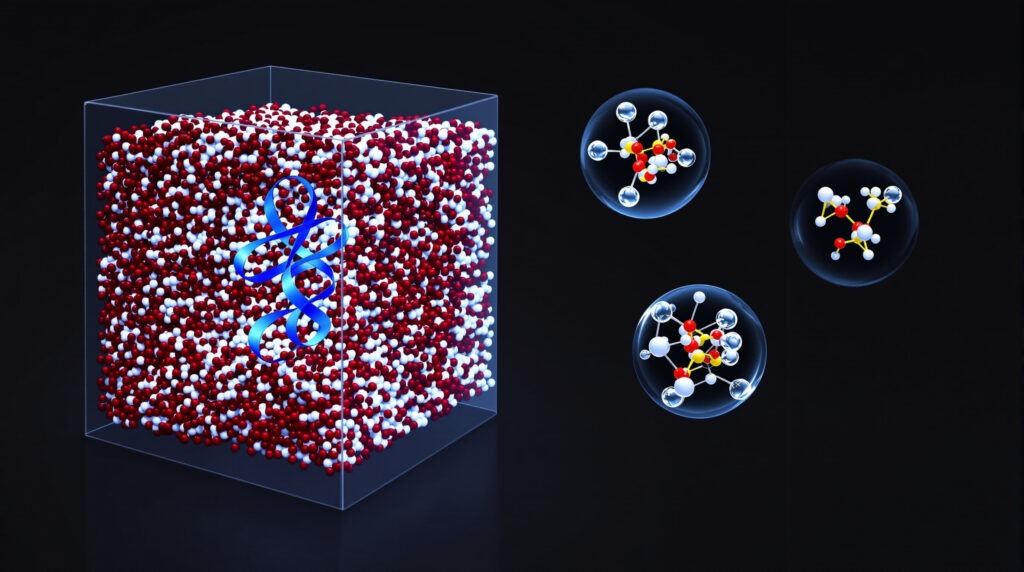
Use the water model your force field was parameterised with. In GROMACS that means TIP3P for AMBER and CHARMM, SPC (or SPC/E) for GROMOS, and TIP4P for OPLS-AA. GROMACS marks this choice as “recommended” in each force field’s menu. Choose it with -water in gmx pdb2gmx, then solvate with the matching box: spc216.gro for 3-site models, tip4p.gro for 4-site models.
Most students meet the water model question at a prompt they did not expect. You run gmx pdb2gmx, pick a force field, and GROMACS immediately asks you to “Select the Water Model” from a list of five to seven options. The choice looks cosmetic. It is not. Water is usually most of the atoms in a solvated protein system, so its parameters shape diffusion, dielectric screening, ion behaviour and hydration of your ligand. This guide from the StemSkills Lab team (10+ years in structural bioinformatics, drug design and molecular modeling) explains the pairing rule, what the three classic models actually differ in, and the errors that follow a mismatch. It belongs to the system-setup stage of our molecular dynamics with GROMACS learning path.
What is a water model in molecular dynamics?
A water model is a fixed recipe for representing one water molecule: where its interaction sites sit, what partial charge each site carries, and which Lennard-Jones parameters act between oxygens. Classic biomolecular models are rigid (GROMACS holds their geometry fixed with the SETTLE algorithm) and non-polarisable (charges never change in response to the surroundings). Every model is a compromise, fitted to reproduce a chosen set of experimental properties such as density and heat of vaporisation.
The models differ in two ways:
- Number of sites. 3-site models (SPC, SPC/E, TIP3P) put the negative charge on the oxygen. 4-site models (TIP4P, TIP4P-Ew, OPC) move it to a massless virtual site, called
MWin GROMACS topologies, on the bisector of the H-O-H angle. 5-site TIP5P adds two lone-pair sites. - Geometry and charges. SPC-family models use an idealised tetrahedral angle; TIP-family models use the experimental gas-phase geometry.
The values below come straight from the topology files shipped with GROMACS 2026.4 (share/top/oplsaa.ff/*.itp), so you can check them on your own installation.
| Model | Sites | O-H length (nm) | H-O-H angle | Charge on H | Negative charge (site) | Original paper |
|---|---|---|---|---|---|---|
| SPC | 3 | 0.1 | 109.47° | +0.41 | -0.82 (O) | Berendsen et al., 1981 |
| SPC/E | 3 | 0.1 | 109.47° | +0.4238 | -0.8476 (O) | Berendsen, Grigera and Straatsma, 1987 |
| TIP3P | 3 | 0.09572 | 104.52° | +0.417 | -0.834 (O) | Jorgensen et al., 1983 |
| TIP4P | 4 | 0.09572 | 104.52° | +0.52 | -1.04 (MW, 0.015 nm from O) | Jorgensen et al., 1983 |
SPC/E differs from SPC only in its charges. Berendsen and co-workers added a self-polarisation energy correction (the “E” stands for extended), which raised the dipole and improved density and diffusion. TIP3P and TIP4P were both introduced in the same paper by Jorgensen, Chandrasekhar, Madura, Impey and Klein, “Comparison of simple potential functions for simulating liquid water” (Journal of Chemical Physics, 1983, volume 79, page 926).
Which water model goes with which force field in GROMACS?
You do not need to memorise this from papers. Every force field directory in GROMACS contains a watermodels.dat file that lists the allowed water models and flags the one the force field was developed with. These are the flags in the GROMACS 2026.4 source tree:
Force field (-ff name) | Water models offered | Marked “recommended” |
|---|---|---|
amber99sb-ildn, amber03 | TIP3P, TIP4P, TIP4P-Ew, TIP5P, SPC, SPC/E | TIP3P |
amber14sb | OPC, OPC3, SPC, SPC/E, TIP3P, TIP4P-Ew | TIP3P (TIP4P-Ew “also recommended”) |
amber19sb | OPC, OPC3, SPC, SPC/E, TIP3P, TIP4P-Ew | OPC (OPC3 “also recommended”) |
charmm27 | TIP3P, TIP4P, TIPS3P, TIP5P, SPC, SPC/E | TIP3P |
gromos54a7 | SPC, SPC/E | SPC |
oplsaa | TIP4P, TIP4P-Ew, TIP3P, TIP5P, SPC, SPC/E | TIP4P |
You can print the file yourself. On a standard install it sits under the GROMACS data directory:
cat $GMXDATA/top/oplsaa.ff/watermodels.datIf $GMXDATA is not set, source GMXRC from your installation’s bin folder first.
Two details catch students out. First, CHARMM36m (the version most published protein work uses) is not bundled; you download the port from the MacKerell lab, and it ships its own watermodels.dat. CHARMM was parameterised with a CHARMM-modified TIP3P that carries small Lennard-Jones terms on the hydrogens, which is what the tips3p entry in charmm27 describes. Read the menu line in your port and pick the entry it marks as recommended. Second, the menu lets you pick models that are not marked recommended. GROMACS will not stop you. That freedom is for reproducing a specific paper or testing water sensitivity, not for a default run. Our guide on how to choose a force field in GROMACS covers the force field side of the same decision.
How do TIP3P, SPC/E and TIP4P compare on real water properties?
None of the classic models reproduces liquid water well across the board. The OPC paper by Izadi, Anandakrishnan and Onufriev, “Building Water Models: A Different Approach” (Journal of Physical Chemistry Letters, 2014, volume 5, pages 3863 to 3871), puts it plainly: “none of these models faithfully reproduce all the key properties of bulk water simultaneously.” Their comparison table, at 298.16 K and 1 bar, gives these values:
| Property | TIP3P | SPC/E | TIP4P-Ew | OPC | Experiment |
|---|---|---|---|---|---|
| Density (g/cm³) | 0.980 | 0.994 | 0.995 | 0.997 | 0.997 |
| Static dielectric constant | 94 | 68 | 63.90 | 78.4 | 78.4 |
| Self-diffusion (10⁻⁹ m²/s) | 5.5 | 2.54 | 2.44 | 2.3 | 2.3 |
| Heat of vaporisation (kcal/mol) | 10.26 | 10.43 | 10.58 | 10.57 | 10.52 |
| Temperature of maximum density (K) | 182 | 241 | 276 | 272 | 277 |
The headline for students is the diffusion row. TIP3P water diffuses about 2.4 times faster than real water (5.5 against 2.3). That is the price of a cheap, widely used model, and it is why kinetic quantities computed in TIP3P (diffusion of a ligand, water residence times) should be compared with care. SPC/E and the 4-site models land much closer on diffusion, but under-shoot the dielectric constant. Original TIP4P is not in that table. For a broader ranking, Vega and Abascal scored rigid models against 17 properties in “Simulating water with rigid non-polarizable models: a general perspective” (Physical Chemistry Chemical Physics, 2011, volume 13, page 19663), with average scores of 2.7 for TIP3P, 4.7 for TIP4P, 5.1 for SPC/E and 7.2 for TIP4P/2005 out of 10.
So why does everyone still use TIP3P? Because the AMBER and CHARMM protein parameters were tuned alongside it. Swapping in a “better” water under a force field that was balanced against TIP3P can make the protein less accurate, not more. Water accuracy on its own is the wrong scoring rule; consistency with the solute parameters comes first.
Want the guided, hands-on version?
Our live Molecular Modeling & MD Simulations cohort bootcamp takes you from zero to running real docking and MD workflows, with a portfolio project for your grad-school applications.
How do I set the water model in GROMACS?
The choice happens at two commands, and they must agree.
Step 1: choose it in pdb2gmx
Skip the interactive menu and make the choice explicit, so it is recorded in your shell history and your methods notes:
gmx pdb2gmx -f protein.pdb -o processed.gro -p topol.top -ff amber99sb-ildn -water tip3p -ignhThe -water option accepts select, none, opc, opc3, spc, spce, tip3p, tip4p, tip4pew, tip5p and tips3p (see the gmx pdb2gmx reference). Only the models listed in the chosen force field’s watermodels.dat will work with it. For the full set of pdb2gmx flags, see our pdb2gmx tutorial.
Confirm what was written. The end of topol.top should include the water file for the model you chose:
grep -n "itp" topol.topFor the command above you should see #include "amber99sb-ildn.ff/tip3p.itp". If you picked OPLS-AA with TIP4P, it reads oplsaa.ff/tip4p.itp. Our GROMACS topology file guide explains every section of that file.
Step 2: solvate with a matching coordinate box
Define the box, then fill it:
gmx editconf -f processed.gro -o boxed.gro -c -d 1.0 -bt dodecahedron
gmx solvate -cp boxed.gro -cs spc216.gro -o solv.gro -p topol.top
The -cs file is a pre-equilibrated box of water coordinates. GROMACS ships three: spc216.gro, tip4p.gro and tip5p.gro. The gmx solvate documentation states that the SPC coordinates “can also be used for other 3-site water models, since a short equilibration will remove the small differences between the models.” So:
| Water model chosen in pdb2gmx | Atoms per water | Use with -cs |
|---|---|---|
| SPC, SPC/E, TIP3P, TIPS3P, OPC3 | 3 | spc216.gro |
| TIP4P, TIP4P-Ew, OPC | 4 | tip4p.gro |
| TIP5P | 5 | tip5p.gro |
The rule underneath the table: the atom count per water in the coordinate box must equal the atom count in the water topology. gmx solvate does not check this for you. The mismatch only surfaces at the next gmx grompp, usually when you prepare for adding ions with genion.
What errors does a wrong water model cause?
“number of coordinates in coordinate file does not match topology”
Cause: the most common case is a 4-site topology (TIP4P, TIP4P-Ew or OPC) solvated with spc216.gro. Each water in solv.gro has 3 atoms; each water in the topology expects 4. grompp stops with a fatal error that reports both counts.
Fix: go back to the solvation step and re-run gmx solvate with -cs tip4p.gro on a fresh copy of the pre-solvation topology. Do not edit the SOL count by hand to make the numbers agree; the coordinates are still missing the virtual site.
Warnings about non-matching atom names
Cause: the coordinate file and topology list water atoms in a different order or with different names, for example a hand-assembled system that mixes boxes. grompp warns and uses the names from the topology, but a mismatch here often means the wrong water file is included.
Fix: check the #include line for water in topol.top and the atom names of the first few SOL lines in your .gro. They must describe the same model. Do not raise -maxwarn to push past this.
No error, wrong science
The quietest failure is a run that completes. CHARMM36m protein in SPC/E, or GROMOS in TIP3P, will run without complaint. Ion parameters make this worse: the Joung and Cheatham monovalent ion set (Journal of Physical Chemistry B, 2008, volume 112, pages 9020 to 9041) was fitted separately for TIP3P, TIP4P-Ew and SPC/E. A reviewer who sees a mismatched water model in your methods section will ask why, and “it was the default in the menu” is not an answer.
When should I deviate from the recommended water model?
Three cases justify it:
- Reproducing a published study. Use exactly the force field and water the paper used, even if newer options exist, so your numbers are comparable.
- A force field that was re-balanced for a 4-site water. AMBER ff19SB was developed with OPC, which is why the bundled
amber19sbmenu marks OPC as recommended. Running ff19SB in TIP3P throws away that balance. - Water itself is the subject. If you study water structure, ice or water diffusion, a pure-water model with good bulk properties (TIP4P/2005 or OPC) is the defensible choice; check that your solute parameters were validated with it.
Cost is rarely the deciding factor for a student project, but it is real: a 4-site model adds a virtual site to every water, so the water part of the system carries one-third more interaction sites than with a 3-site model. Measure the effect on your own hardware with a short run before committing to long production.
How do I check the water model worked after equilibration?
After NVT and NPT equilibration, extract the density:
gmx energy -f npt.edr -o density.xvgType the number for Density at the prompt, then 0. The average should settle close to, and slightly below or above, the model’s own pure-water density (TIP3P runs a little low, 0.980 g/cm³ in the table above), not exactly at 0.997. A value far off points to a setup problem, not the water model. You can also compute the oxygen-oxygen radial distribution function with gmx rdf; the first peak should appear near 0.28 nm (2.77 Å for TIP3P in the OPC paper’s table).
Finally, write it down. A complete methods sentence reads: “The protein was described with AMBER99SB-ILDN and solvated with TIP3P water (Jorgensen et al., 1983) in a rhombic dodecahedron with a 1.0 nm minimum solute-box distance.” Where this step fits among the other skills you need is laid out in our computational biology skills roadmap.
Frequently asked questions
Is TIP3P or SPC/E better for protein simulations in GROMACS?
Neither is better in general. SPC/E reproduces water’s diffusion and density more closely, but AMBER and CHARMM protein parameters were balanced against TIP3P, so TIP3P is the correct choice for them. Use SPC or SPC/E with GROMOS force fields, which were developed for that family.
Can I use spc216.gro for TIP3P water?
Yes. The GROMACS solvate documentation says the SPC coordinates can be used for any 3-site model, because a short equilibration removes the small geometric differences. Use tip4p.gro for TIP4P, TIP4P-Ew and OPC, and tip5p.gro for TIP5P.
What is the MW atom in a TIP4P topology?
MW is a massless virtual site that carries the model’s negative charge (-1.04 in TIP4P), placed 0.015 nm from the oxygen along the H-O-H bisector. GROMACS reconstructs its position from the three real atoms at every step, so it adds an electrostatic site but no extra degrees of freedom.
Which water model does CHARMM36m use in GROMACS?
The CHARMM-modified TIP3P, which adds small Lennard-Jones parameters to the hydrogens. Download the CHARMM36 port from the MacKerell lab and select the water entry its menu marks as recommended.
Does the water model affect docking or MM-PBSA results?
It affects any result taken from the explicit-water trajectory: binding pose stability, hydrogen-bond lifetimes, ligand RMSD and the snapshots fed into MM-PBSA. Docking itself uses no explicit water model. Keep the water consistent with the force field so these numbers can be compared with published work.
Written by the StemSkills Lab team. Commands and file contents were checked against the GROMACS 2026.4 documentation and source tree on 31 October 2026.
Want the guided, hands-on version?
Our live Molecular Modeling & MD Simulations cohort bootcamp takes you from zero to running real docking and MD workflows, with a portfolio project for your grad-school applications.